

Virtual Reality as Pedagogical Space | Virtual Reality Simulation Video
Files
Date of Award
Spring 2026
Degree Name
Master of Fine Arts (MFA) in Visual Communication Design
Department
Art
Committee Chair
Patrice Anderson
Exhibition Date
4-2026
Description
View the Digital Exhibition of Virtual Reality as Pedagogical Space
This research presents an immersive, culturally grounded pedagogical framework that integrates Virtual Reality (VR) with experiential and project-based learning. Despite the potential of immersive technologies to enhance engagement, contemporary design curricula often exhibit a disconnect between theoretical instruction and embodied practice. This study addresses that gap by aligning virtual reality and emerging technology with design theories, culturally responsive pedagogies and localized knowledge systems.
Drawing upon David Kolb’s experiential learning cycle, the research validates active engagement and reflection into interactive, three-dimensional environments. The research also adopted two other frameworks in the approach of user’s familiarity with virtual reality and adoption i.e. The Technology Acceptance Module (TAM) by Fred Davis and the Technological, Pedagogical and Content Knowledge (TPACK) which further emphasized the importance of understanding the relationship between the three areas and how to best integrate that in a teaching methodology to provide the best experience to learners.
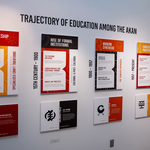
This project is operationalized and was exhibited in the Art+Design department of Jacksonville State University through a VR prototype centered on the semiotic systems of the Akan people of Ghana. By enabling students to interpret and interact with cultural narratives within a spatial environment, this approach repositions design education as a participatory, embodied process rather than a passive acquisition of information. The study finally presents usability data gathered from students after interaction with the exhibition to evaluate the success and future iterations of the project.
Loading...